

Valorant Rank System Explained: All Valorant Ranks, RR and Resets
Team StanShop
~5 min
Valorant is Riot Games' free-to-play 5v5 tactical shooter, and Competitive mode is where most players test themselves. Valorant ranks run from Iron at the bottom to Radiant at the top. Between them sit hidden MMR, RR swings, rank shields, and resets that confuse even regular players. This guide explains each part in plain words, so you know where you stand and how to climb.
All Valorant Ranks in Order
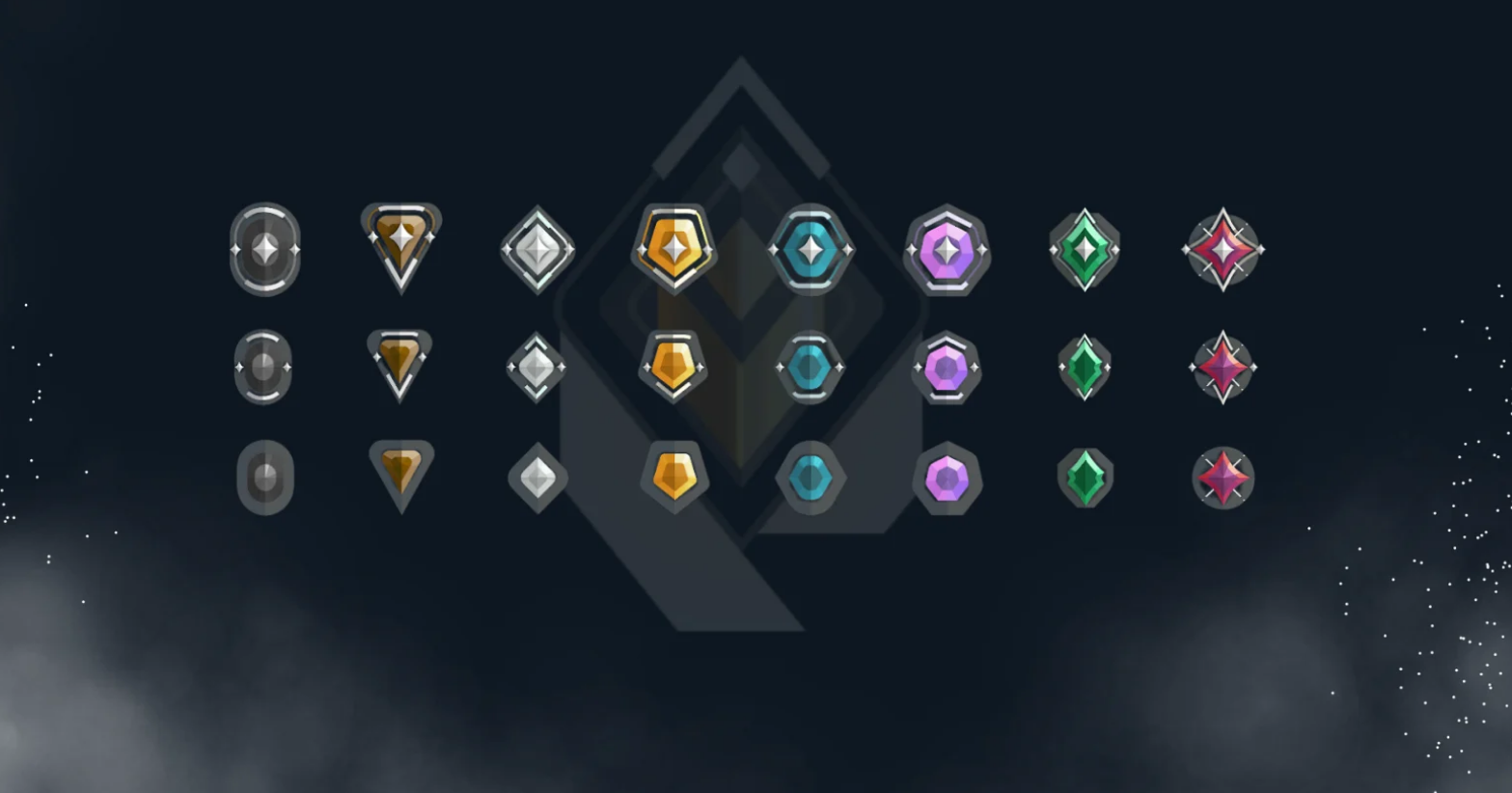
Valorant has nine ranks split into 25 tiers. Iron 1 sits at the bottom, and Radiant stands alone at the top. Every rank from Iron to Immortal has three tiers, and Tier 3 is always the highest. So Silver 3 promotes into Gold 1, not Gold 3.
Here's the full ladder, along with how the player base spread across it during a recent Act.
| Rank | Share of Ranked Players | Reaching Tier 1 Beats Roughly |
| Iron | About 5% | Starting point |
| Bronze | About 16% | 5% of players |
| Silver | About 21% | 20% of players |
| Gold | About 22% | 41% of players |
| Platinum | About 18% | 63% of players |
| Diamond | About 12% | 81% of players |
| Ascendant | About 6% | 92% of players |
| Immortal | About 1.4% | 98.6% of players |
| Radiant | About 0.05% | Top 500 per region |
Gold 2 is the true middle of the ladder. Reach it, and you're ahead of about half of all ranked players. These numbers shift a little every Act, especially right after a reset.
How to Unlock Ranked Mode in Valorant?
Competitive stays locked until your account hits Level 20. Unrated, Swiftplay, and other modes that pay account XP all count toward it.
Your first five ranked games are placement matches. They decide your starting rank, and the highest possible placement is Ascendant 3. Nobody places straight into Immortal.
Once an account reaches Ascendant, Riot asks you to verify it through Riot Mobile multi-factor authentication. You'll see a Verify Account button instead of Start until you finish it. The requirement stays even if you drop back down.
How Rank Rating (RR) Works in Valorant?
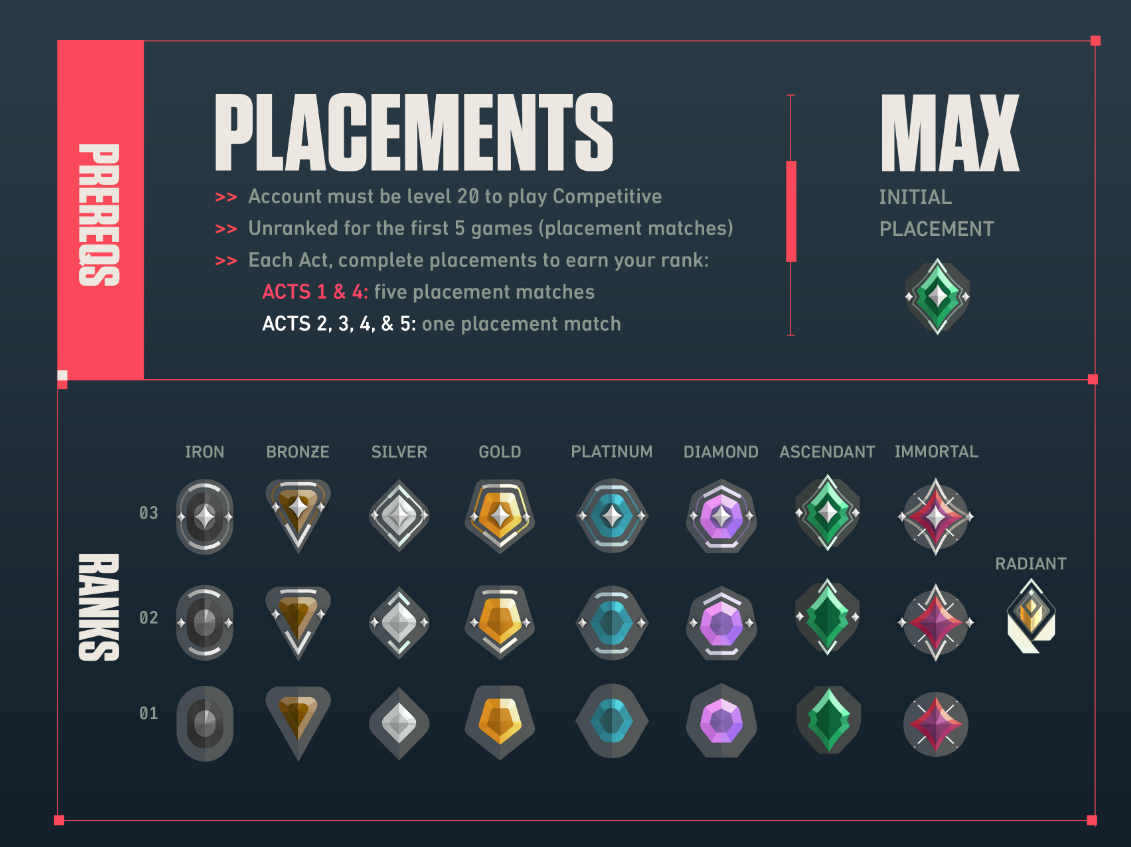
Rank Rating, or RR, is the progress bar under your rank icon. Each tier from Iron 1 to Ascendant 3 runs from 0 to 100 RR. Hit 100, and you move up a tier with at least 10 RR. In most tiers, a loss at 0 RR drops you down, though you land with 70 RR or more.
Most matches move you somewhere around 10 to 30 RR either way. The exact amount comes down to four factors.
What Decides Your RR After a Match?
| Factor | What It Means for You |
| Match result | Winning earns RR and losing costs RR. This factor matters most, and a loss never earns RR. |
| Round difference | A 13-2 win pays more than a 13-11 win. A 3-13 loss also hurts more than an 11-13 loss. |
| Individual performance | Damage, assists and kills can slightly boost a gain or soften a loss. Its effect shrinks at Immortal and Radiant. |
| Rank convergence | Riot compares your visible rank with your hidden MMR, then scales your RR to close the gap. |
Hidden MMR and Why Your RR Feels Uneven
MMR (Match-Making Rating) is Riot's hidden read on your skill. You can't see it, but it picks your lobbies and scales every RR change.
If your MMR sits above your rank, wins pay big and losses sting less. If it sits below your rank, the reverse happens. That's why one player can gain far more per win than a friend at the same rank. A big enough gap can even trigger a double promotion, like jumping from Gold 1 straight to Gold 3.
A former Riot designer said most accounts need 20 to 40 games for rank and MMR to line up. Once your gains and losses feel roughly equal, you've reached that point. At lower ranks, MMR also tracks who you beat in duels. Taking down the enemy's strongest player moves it more than farming their weakest.
Rank Shields and Demotion
Rank Shields give you breathing room after you enter a new rank. You get two shields in Tier 1 of every rank except Radiant.
- A loss at 0 RR burns one shield.
- A third loss at 0 RR demotes you, for example, from Gold 1 to Silver 3.
- Shields refill only when a promotion or demotion moves you into Tier 1. Winning your way back to 10 RR doesn't refill them.
- Tiers 2 and 3 have no shields, so one loss at 0 RR drops you a tier.
You can check your remaining shields on the Rank Details screen in the client.
Other Factors that Impact your Valorant RR
- Draws can add up to 20 RR from Iron to Ascendant, and they never take RR away.
- Dodging a lobby during agent select costs a small amount of RR.
- Going AFK for three or more rounds adds an 8 to 12 RR penalty on top of the result.
- If a confirmed cheater costs you a match, Riot refunds that RR after banning them. You collect it once your next ranked match ends.
- New or reworked maps usually launch with halved RR losses for their first two weeks.
Immortal and Radiant Ranks Work Differently than the Rest

The top of the ladder plays by different rules. Once you reach Immortal 1, RR stops resetting at 100. It keeps stacking with every win.
Moving up to Immortal 2 and Immortal 3 depends on RR thresholds that Riot sets for each region. Radiant needs two things at once. You must pass your region's Radiant threshold and hold a top 500 spot on its leaderboard.
At this level, the match result does nearly all the work. Personal performance counts for very little. Fall below a threshold, or slip past the 500th spot, and you drop back down.
Two more rules apply up here. You must play at least one ranked game every seven days to keep your leaderboard spot. Immortal and Radiant players can also queue only solo, as a duo, or as a full five-stack.

Valorant Rank Resets, Acts and Placement Matches
Valorant now runs on yearly Seasons. Each Season holds six Acts, and each Act lasts around two months. Your rank doesn't wipe with every new Act, though. Full resets happen only twice a year.
| When It Happens | Placement Matches | What Happens to Your Rank |
| Season start (Act 1) | 5 | Full reset with a clear drop. Ascendant 3 is the highest placement. |
| Mid-Season (Act 4) | 5 | Another reset, usually with a softer drop. |
| Acts 2, 3, 5 and 6 | 1 | Your rank returns after one game and may shift slightly. |
| Immortal and Radiant, between Acts | 1 | RR drops by 90%, and every Radiant falls to Immortal. |
Your hidden MMR mostly carries over through each reset. Strong players climb back quickly because their early wins pay big RR. Valorant also has no rank decay. Take a long break, and your rank waits for you.
Who Can You Queue With in Valorant Ranked?
Valorant allows solo players, duos, trios, and five-stacks in Competitive. Four-player parties can't queue at all. Duos and trios also have to fit inside a rank range.
| Your Rank | Who You Can Duo or Trio With |
| Iron or Bronze | Anyone from Iron 1 to Silver 3 |
| Silver | Anyone from Iron 1 to Gold 3 |
| Gold | Anyone from Silver 1 to Platinum 3 |
| Platinum to Ascendant | Players up to three tiers above or below you |
| Immortal and Radiant | Duos only, within three tiers |
Five-stacks skip these limits entirely. The catch is RR. A balanced five-stack that fits the duo rules pays out normally. Spread the ranks wider, or bring an Immortal along, and everyone's RR swings shrink by 25%. Parties with a Radiant player face cuts of 75% to 90%.
Valorant Act Rank and Ranked Rewards
Your Act Rank is separate from your current rank. It shows your proven skill, which means the highest-ranked win you earned that Act.
Each win drops a small triangle into a badge on your career screen. Wins at higher ranks push lower ones out. The badge border upgrades at 9, 25, 50, 75, and 100 wins.
Nine wins is the number to remember. Hit it, and your peak Act Rank counts toward your ranked reward. For years, that reward has been a gun buddy, handed out at Mid-Season and at the end of each Season.
That system is changing. Riot is retiring gun buddies as the main ranked reward. Starting in 2027, players get Competitive Flex instead. It's an item that evolves across the year and upgrades with each Act.
Tips to Climb Valorant Ranks Faster
A few habits help almost everyone climb:
- Play 20 to 40 games in an Act before deciding you're stuck. Your rank needs that long to catch up with your MMR.
- Don't surrender games you can still close. A narrow loss costs far less RR than a blowout.
- Lock agents who create value without perfect teamwork. Our Valorant tier list (Valorant Tier List link) shows which agents win the most ranked games right now.
- Take fights against the strongest enemy when the odds favor you. Beating better players lifts your MMR faster.
- Stop after two or three straight losses. Tilt costs more RR than any bad map.
Unlock the Latest Valorant Agents Faster With StanShop Gift Cards!
In Valorant, ranked has no pay-to-win angle. No skin, bundle, or battle pass tier adds a single RR. Valorant Points cover everything around the climb, though. That includes new agents, the premium battle pass, and a skin for the gun you finally master.
A Valorant Points gift card is the simplest way to load VP without linking a card to your Riot account. On StanShop, your code lands in the Orders section the moment payment clears. UPI, net banking, and cards all work, and each purchase adds StanShop coins to your balance. Shopping for more than one game? The full range of gaming gift cards sits in one place, with live chat support around the clock.
Want to save first? Our guide to free Valorant Points and skins lists the methods that actually pay out.
Frequently Asked Questions
1. How many ranks are there in Valorant?
Valorant has nine ranks: Iron, Bronze, Silver, Gold, Platinum, Diamond, Ascendant, Immortal, and Radiant. The first eight have three tiers each, so the ladder has 25 tiers in total.
2. What is the average rank in Valorant?
Gold is the most common rank, and Gold 2 sits right in the middle of the ladder. Reaching it puts you ahead of about half of all ranked players.
3. How much RR do you get for a win in Valorant?
Most wins earn around 10 to 30 RR. The exact amount depends on round difference, your performance, and the gap between your rank and hidden MMR.
4. Does Valorant have rank decay?
No. Your rank stays put during long breaks. Immortal and Radiant players must play one ranked game every seven days to keep their leaderboard spot, though.
5. What level do you need to play ranked in Valorant?
You need Account Level 20. After that, five placement matches set your starting rank, with Ascendant 3 as the highest possible placement.
6. How often do Valorant ranks reset?
Ranks reset twice a year, at the start of each Season and at Mid-Season. Both resets need five placement matches. Other Acts need just one.
7. Can Iron and Gold players queue together in Valorant?
Not as a duo or trio. Iron players can only party with ranks up to Silver 3. A five-stack works, but everyone's RR gains and losses shrink.
Why be Average?
Get Valorant Points Gift Card - INDIA on StanShop and save more on every order.
Buy NowRead Similar Blogs

All Among Us Characters: Every Role, Color and Crewmate Explained
Among Us is Innersloth's social deduction game. A crew of bean-shaped astronauts keeps a ship running while hidden Impostors pick them off. Each match hands you a color and a role, and both shape how you play. This guide covers all Among Us characters, from the classic Crewmate to the newest ghost roles. You'll also meet all 18 colors and the voice cast behind the animated show.
~5 min

EA FC 27 Mobile Redeem Codes for October 2026
FC Mobile 27 season is already in full swing, and the recent FIFA World Cup only fueled its popularity. Touted as one of the best football RPGs on mobile, the game continues to receive love from the developers and players alike. New events, new player cards, and new tactics follow suit. To get more players, you need tons of Gems. And the best way to get them is via our FC Mobile redeem codes. These codes are officially supported by the developers and give out instant free rewards.
~4 min

Valorant Tier List: All Agents Ranked From Best to Worst
Ever top-fragged on Jett and still lost the match? It happens a lot in Valorant, Riot's 5v5 tactical shooter. Utility and team fit decide rounds just as often as raw aim does. This Valorant tier list ranks every agent by how often they win ranked games, not how flashy they look. Since each agent's playstyle is unique, consider this tier list as reference, and it’s not entirely objective.
~4 min